That sinking feeling when you’re carving through fresh powder but can’t distinguish bumps from wind drifts? Or when flat light turns the mountain into a featureless white void? Choosing the wrong ski goggle lens color transforms exhilarating runs into dangerous guessing games. Your lens isn’t just tinted glass—it’s your primary navigation tool on the mountain. This ski goggle lens color guide cuts through marketing hype to deliver exactly what you need: actionable knowledge to match lenses to light conditions. You’ll learn why VLT (Visible Light Transmission) matters more than color names, how to avoid the polarized lens trap, and why most experts swear by a two-lens system. Stop compromising visibility—let’s get you seeing terrain contours clearly in any weather.
Why Your VLT Rating Determines Mountain Safety
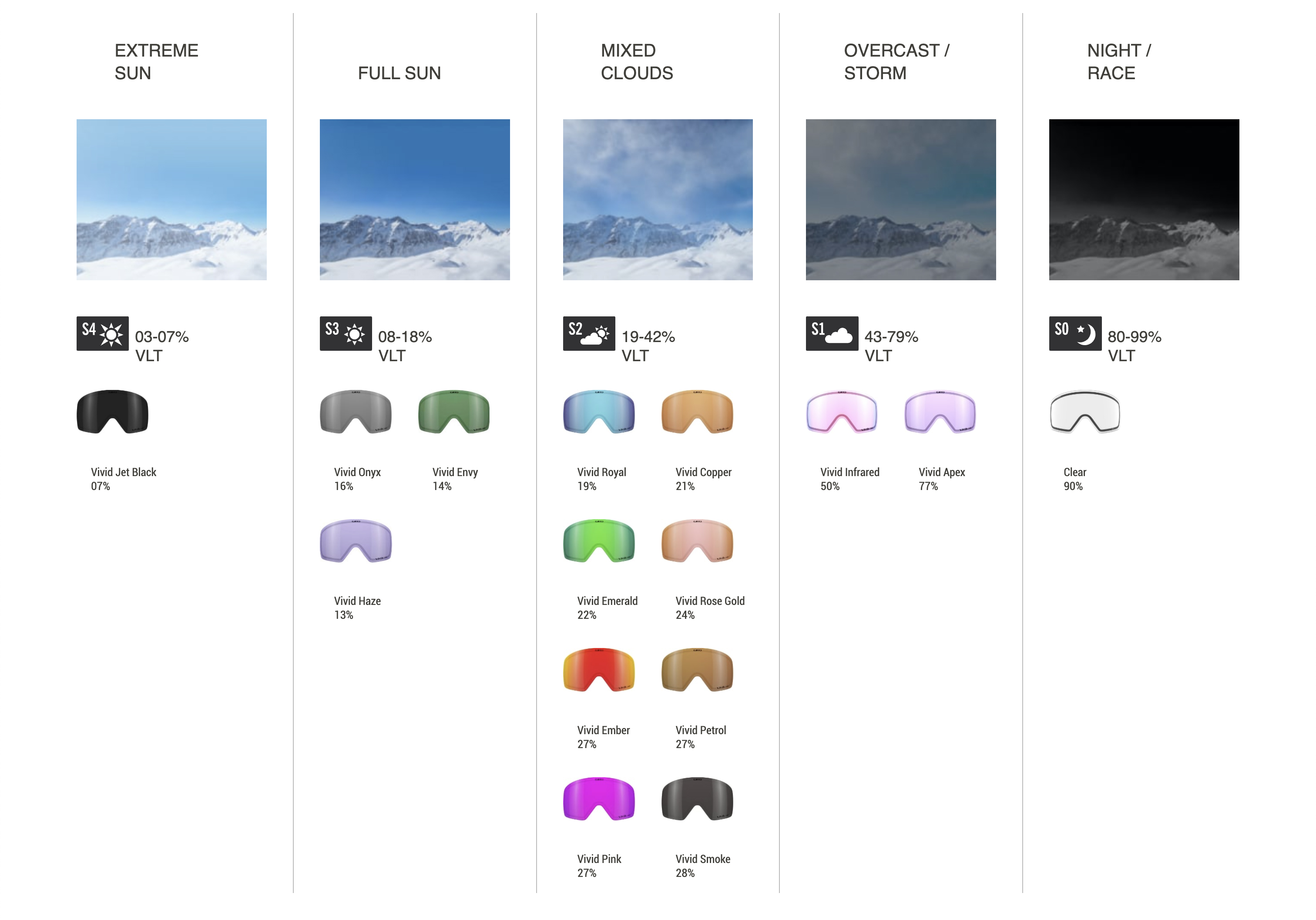
Visible Light Transmission (VLT) is the non-negotiable foundation of goggle lens selection—it measures the percentage of light passing through your lens. Forget color names; a 10% VLT lens blocks 90% of light, making it essential for high-altitude glare, while an 80% VLT lens floods your eyes with light during whiteout storms. The critical mistake? Assuming “gray” always means sunny-day lens. A gray lens with 40% VLT (like Smith’s ChromaPop Sun) actually works for variable light, while a mirrored rose lens at 12% VLT (Oakley Prizm Black Iridium) handles intense sun. Your safety depends on matching VLT to conditions: too dark in flat light causes missed obstacles, while too light in bright sun induces squinting and eye fatigue. Always check the actual VLT percentage—not just the color name—on your lens packaging.
Bright Sun: Stop Squinting on Bluebird Days (5-15% VLT)
When sun-baked snow reflects blinding glare at 10,000 feet, you need serious light reduction. Gray, gray-green, or dark brown lenses with mirror coatings are your only defense. These cut light evenly across the spectrum without distorting colors—critical for spotting ice patches. Oakley’s Prizm Black Iridium (11% VLT) and Anon’s Black Iridium use mirrored coatings that reflect 30-50% of light before it hits the tinted base, preventing the “flat white wall” effect. Never skip the mirror: on spring glacier days, a non-mirrored gray lens at 15% VLT still causes eye strain. Pro tip: If your goggles fog instantly when you step outside on sunny days, your VLT is too high—switch to 10% or lower immediately.
Variable Light: Your Daily Driver for Changing Skies (15-40% VLT)
This VLT range handles 80% of resort skiing—from dawn patrol to afternoon cloud cover. Rose, copper, and amber base lenses dominate here because they selectively block blue light (the culprit behind flat-light disorientation) while amplifying reds and yellows. Smith’s Ignitor lens (35% VLT) makes snow texture “pop” under patchy clouds by warming the visual field. These are your true all-mountain workhorses: Oakley Prizm Rose (43% VLT) transitions seamlessly from morning shade to midday sun. Avoid gray lenses here—they lack contrast enhancement when clouds roll in. Warning: If you constantly remove goggles during partly cloudy days, your lens VLT is too low. Target 25-40% for reliable performance across shifting conditions.
Flat Light Emergencies: See Terrain in Storms (40-75% VLT)
When snow clouds erase shadows and the mountain disappears into a white void, high-VLT contrast lenses become lifesavers. Persimmon, rose, and bright amber tints (like Anon’s Rose or Smith’s Rose Flash) filter blue wavelengths that cause visual flatness, revealing subtle snow texture changes. At 63% VLT, persimmon lenses “warm” the scene by boosting orange tones—turning indistinguishable bumps into visible contours. This isn’t about brightness alone; it’s targeted contrast. If you’re skiing in heavy snowfall, avoid yellow lenses—they create excessive halos. Instead, choose rose-based options that maintain depth perception. Critical check: In true flat light, if tree shadows look identical to snowbanks, your lens VLT is below 40%—upgrade immediately.
Whiteout Survival: Low-Light Lenses That Save Runs (75-90%+ VLT)
For pre-dawn backcountry tours or blinding snowstorms, only high-intensity yellow or light rose lenses provide usable vision. These 80-90% VLT lenses maximize light intake while still cutting hazardous blue glare—think of them as visual headlights. Smith’s High-Intensity Yellow lens (85% VLT) is legendary for making ice crystals visible in near-total darkness. Never use clear lenses: they lack blue-light filtration, causing dangerous visual noise in storms. If you’re navigating in true whiteout conditions, verify your lens has at least 75% VLT; below that, depth perception fails. Pro move: Carry these as your emergency lens—they turn last-light survival runs into manageable descents.
Mirror, Polarized & Photochromic: Tech That Helps (or Hurts)
Mirror Coatings: Your Secret Weapon Against Glare
That flashy mirror isn’t cosmetic—it’s a functional light shield. Silver, blue, or gold coatings reflect 10-60% of light before it hits the tinted lens, effectively lowering VLT without changing base color. A rose lens with blue mirror (like Oakley Prizm Rose Iridium) becomes a 20% VLT performer for variable sun, while keeping its contrast-boosting properties. Crucially, mirror color doesn’t affect performance—only reflectivity matters. Avoid scratched mirrors: compromised coatings create distracting light patterns. Always prioritize mirror quality over color matching your jacket.
Polarized Lenses: The Ice Detection Danger
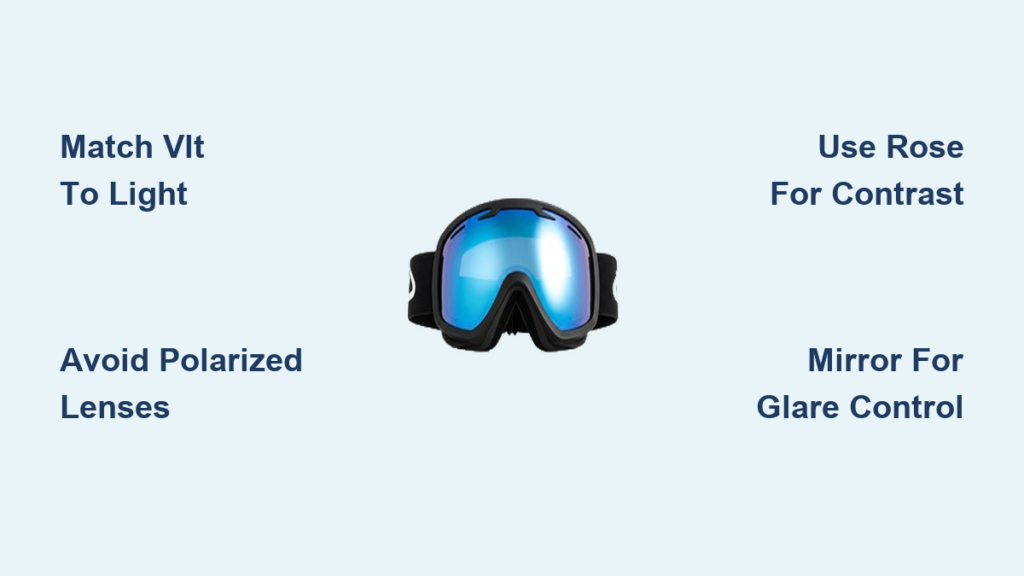
Polarized lenses eliminate horizontal glare—perfect for fishing, disastrous for skiing. By blocking all horizontal light waves, they hide the critical “sheen” of glare that signals icy patches on snow. In testing, polarized lenses reduced reaction time to ice by 1.2 seconds—enough to cause a collision at 20mph. Skip them unless skiing on glacier snow with zero variable terrain. If you own polarized goggles, use them only on groomed corduroy in consistent sun.
Photochromic Lenses: Convenience With Caveats
Auto-adjusting lenses like Anon Perceive 100 (20-70% VLT range) excel for mid-mountain variable conditions but fail at extremes. Below 20°F, their chemical reaction slows dramatically—they might stay too dark during morning storms or too light at high noon. Never rely on them for:
– High-altitude spring skiing (needs 10% VLT)
– Heavy snowfall (needs 80%+ VLT)
They’re ideal for late-morning to early-afternoon resort skiing but belong in a multi-lens system, not as your sole solution.
Build Your Winning 2-Lens Quiver in 60 Seconds

Forget carrying three lenses—top guides and patrollers use this battle-tested system:
1. Bright-Day Specialist: 10-15% VLT mirrored lens (e.g., Oakley Prizm Black Iridium). Use when shadows are sharp and snow feels blinding.
2. All-Condition MVP: 25-40% VLT rose/copper base (e.g., Smith Ignitor). Your go-to for 90% of mountain days—works from dawn to dusk in variable light.
Brand contrast tech like Oakley Prizm or Smith ChromaPop isn’t a tint—it’s a molecular filter enhancing specific snow-reflected wavelengths. Prizm Snow lenses, for example, amplify red/orange light from snow texture while suppressing blue haze. This transforms your rose lens from “okay” to terrain-revealing. If buying one lens, choose a rose-based 30% VLT option—it outperforms “all-condition” gray lenses in real-world variable light.
| Conditions | Lens Color (Base) | Ideal VLT | Critical Function |
|---|---|---|---|
| Blinding Sun | Gray/Gray-Green + Mirror | 5-15% | Blocks glare without color distortion |
| Variable Light | Rose/Copper | 15-40% | Cuts blue light for terrain contrast |
| Flat Light | Persimmon/Rose | 40-75% | Warms scene to reveal snow texture |
| Whiteout Storm | High-Intensity Yellow | 75-90%+ | Maximizes light while filtering glare |
| Photochromic | Rose Base | 20-70% | Adaptive for mid-day variable light |
5 Pro Tips That Prevent Goggle Regret
Know your mountain’s personality: Pacific Northwest skiers need high-VLT rose lenses 70% of the time, while Colorado high-alpine riders require dark mirrored lenses for spring corn. Match your primary lens to your home resort’s dominant conditions.
Mirrors = brightness control, not style: A rose lens with violet mirror still functions as a contrast-enhancing rose lens—it’s just darker. Use mirrors to adjust VLT within your preferred base tint.
Start versatile: Your first lens must be rose/copper base at 25-40% VLT. Gray “all-condition” lenses fail in flat light—don’t be fooled by marketing.
Photochromic reality check: They work best between 9 a.m. and 3 p.m. in moderate temperatures. In January’s deep cold or April’s intense sun, they’ll underperform—always carry a dedicated backup.
Never skip lens care: Scratched anti-fog coatings cause visual distortion. Store goggles in microfiber bags away from heat. One drop of lens cleaner per lens—never rub dry.
Your goggle lenses are mission-critical safety gear, not accessories. By matching VLT to conditions and avoiding polarized pitfalls, you transform whiteout anxiety into confident turns. Start with a rose-based 30% VLT lens as your foundation—then add a dark mirrored lens when you chase high-altitude sun. The mountain’s texture is always there; with the right ski goggle lens color guide, you’ll finally see it. Swap lenses before your next run, and feel the difference in your first three turns.