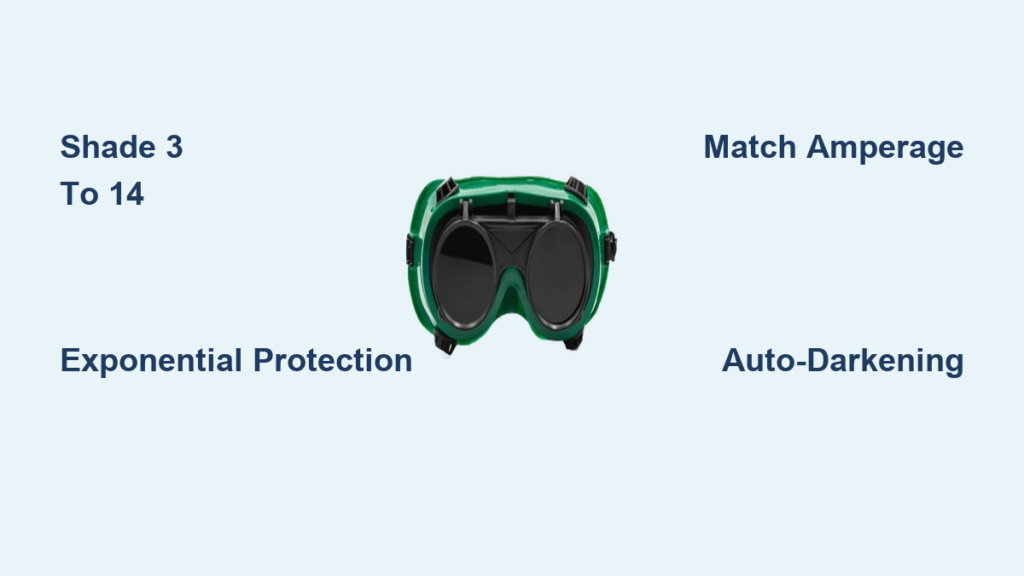
You’re moments away from striking an arc, and a critical question hits you: “Are these goggles dark enough to protect my eyes?” That intense, blinding light from a welding arc isn’t just uncomfortable—it’s dangerously bright, emitting ultraviolet and infrared radiation that can permanently damage your vision in seconds. Welding goggle darkness isn’t a matter of preference; it’s a precise safety requirement measured by standardized shade numbers. The correct answer to “how dark are welding goggles” depends entirely on your specific welding process, but generally ranges from Shade #3 (blocking 91% of visible light) to Shade #14 (blocking over 99.999% of visible light).
Choosing the wrong shade level puts you at serious risk. Too light, and you risk “arc eye”—a painful corneal burn that feels like sand in your eyes. Too dark, and you can’t see your work properly, compromising both safety and weld quality. This guide cuts through the confusion with specific, actionable advice to help you select the perfect shade for your eyes and your welding tasks. You’ll learn exactly how dark welding goggles need to be for every common process, understand the exponential relationship between shade numbers and protection, and discover why proper eye protection is non-negotiable in your welding practice.
Why Welding Goggle Darkness Follows an Exponential Scale
Welding goggle darkness operates on a logarithmic scale, not a linear one—meaning each incremental increase in shade number delivers dramatically more protection. This exponential relationship is crucial for understanding how dark welding goggles truly are. A Shade #5 lens blocks 99.6% of visible light, while moving up just one shade to #6 blocks 99.8%—a seemingly small percentage difference that represents a significant jump in eye protection.
This non-linear progression continues throughout the scale. When you reach Shade #10, the lens blocks 99.97% of visible light, and by Shade #14, that protection jumps to an astonishing 99.999%. This exponential increase explains why selecting even one shade too light can expose your eyes to dangerous levels of radiation. The difference between Shade #10 and #11 isn’t merely “a bit darker”—it’s the difference between adequate protection and risking serious eye damage during certain welding operations.
How Shade Numbers Translate to Real-World Protection
Understanding the practical implications of shade numbers helps you make informed decisions about your eye safety. Shade #3 lenses (blocking 91% of light) are appropriate only for very low-amperage processes like brazing or light gas welding. If you mistakenly use this shade for stick welding, you’d be exposing your eyes to 9 times more harmful radiation than with a Shade #5 lens.
For most electric arc welding processes, you’ll need significantly darker protection. Shade #10 (blocking 99.97% of visible light) is the minimum recommended for many common MIG and TIG applications. At this level, only 0.03% of visible light reaches your eyes—comparable to looking directly at the sun through multiple layers of specialized solar filters. Shade #14, the darkest standard welding shade, allows just 0.001% of visible light to pass through, making it essential for high-amperage processes like carbon arc gouging where the arc intensity is extreme.
Shade Requirements for Every Major Welding Process
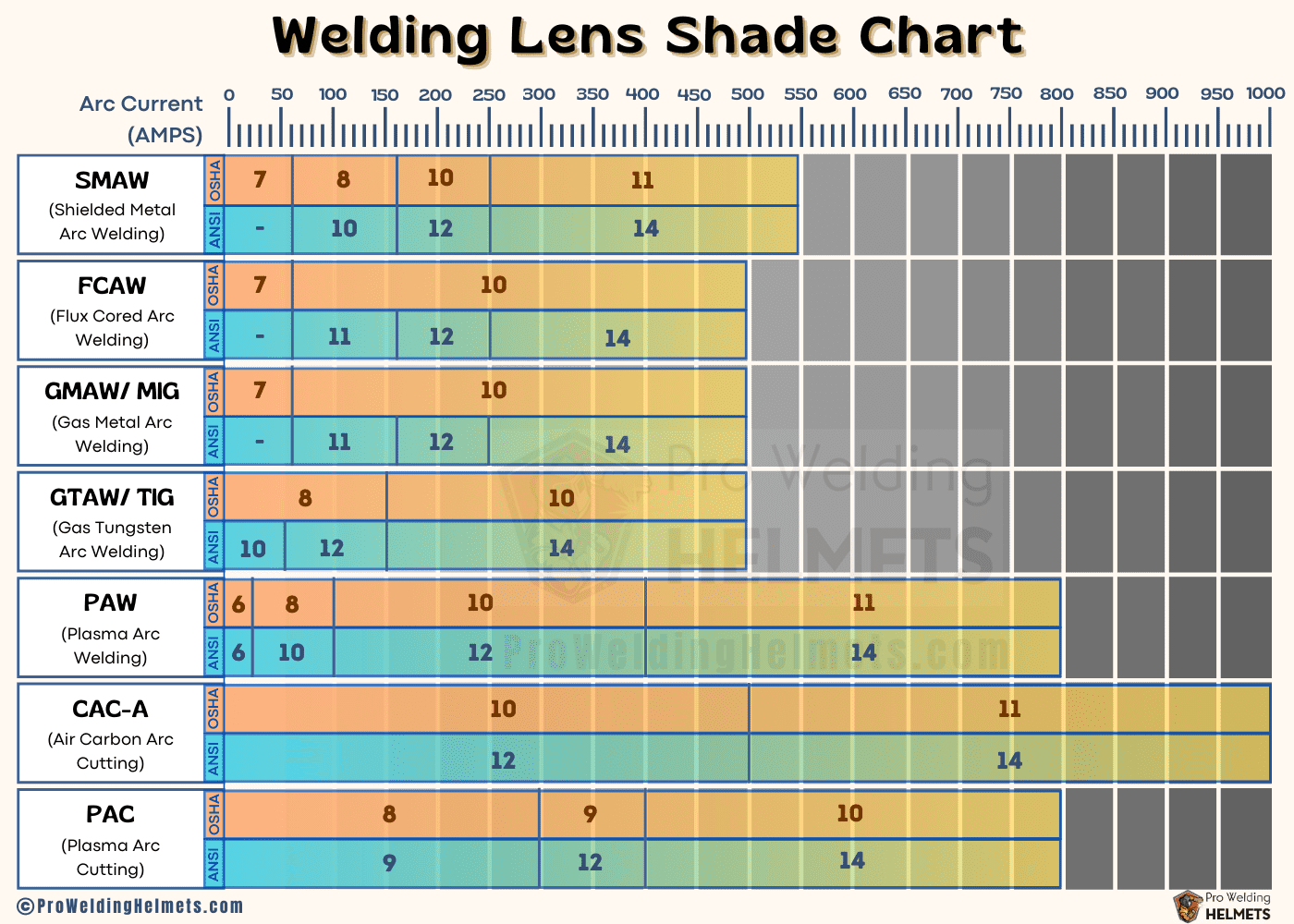
Selecting the right shade isn’t about guessing how dark welding goggles should be—it’s about matching specific protection levels to your exact welding parameters. The wrong shade can cause immediate eye damage or compromise your work quality, so let’s break down precise requirements for common welding methods.
Stick Welding (SMAW) Shade Specifications
For stick welding, your amperage range directly determines the necessary shade level. When working with 40-60 amps on thin materials, you need Shade 7-8 protection. As you move to the most common range of 60-160 amps for general fabrication, Shade 9-10 becomes essential. At the higher end of stick welding (160-250 amps), you must use Shade 11-12 to protect against the intense arc.
Critical warning: If you’re performing high-amperage stick welding (250+ amps) on heavy structural steel, Shade 12-14 is non-negotiable. Using a lighter shade at these amperages exposes you to dangerous levels of ultraviolet radiation that can cause permanent retinal damage in seconds.
MIG/MAG Welding Shade Guidelines
MIG welding requires careful shade selection based on your amperage and material thickness. For light automotive work at 60-100 amps, Shade 9-10 provides adequate protection while maintaining visibility of the weld puddle. As you increase to 100-200 amps for thicker materials, you need Shade 10-11 to handle the brighter arc.
When welding heavy plate at 200-300 amps, Shade 12-13 becomes necessary—this is where many welders make dangerous mistakes by sticking with lighter shades to see better. For industrial applications exceeding 300 amps, Shade 13-14 is your only safe option. Remember that high argon-content shielding gases increase arc brightness, potentially requiring a darker shade than you’d use with CO2-rich mixes at the same amperage.
TIG Welding Shade Requirements
TIG welding presents unique challenges because precision work demands better visibility, yet the arc remains intensely bright. For delicate work under 50 amps on thin materials like jewelry or exhaust components, Shade 8-9 offers the visibility you need while providing sufficient protection.
Most general TIG applications (50-150 amps) require Shade 10-11 protection. Many experienced TIG welders prefer Shade 10 for aluminum work because it provides slightly better puddle visibility without compromising safety. When welding thick aluminum or steel at 150-250 amps, you must upgrade to Shade 12, and for heavy industrial applications exceeding 250 amps, Shade 13-14 becomes essential despite the reduced visibility.
Auto-Darkening Filters: The Modern Solution to Shade Selection
Fixed-shade lenses force you to choose one darkness level, but auto-darkening filters (ADFs) solve this limitation by automatically adjusting to the perfect shade when you strike an arc. These advanced lenses start in a light state (typically Shade 3-5) so you can see your work clearly before welding, then darken to your preset level (usually Shade 8-13) in milliseconds when the arc begins.
Key ADF Features Every Welder Should Know
When shopping for an auto-darkening helmet, focus on these critical specifications:
– Shade range: Look for helmets offering at least Shade 8-13 coverage
– Response time: Quality ADFs darken in 1/20,000th of a second—slower response times risk eye exposure
– Sensitivity adjustment: Allows fine-tuning for different amperages and ambient light conditions
– Delay control: Determines how long the lens stays dark after the arc stops
Pro tip: For TIG welding where precise visibility matters most, choose an ADF with a light state of Shade 3 rather than Shade 5. This seemingly small difference dramatically improves your ability to see fine details during setup and tack welding.
Why Shade Selection Mistakes Cause Permanent Damage
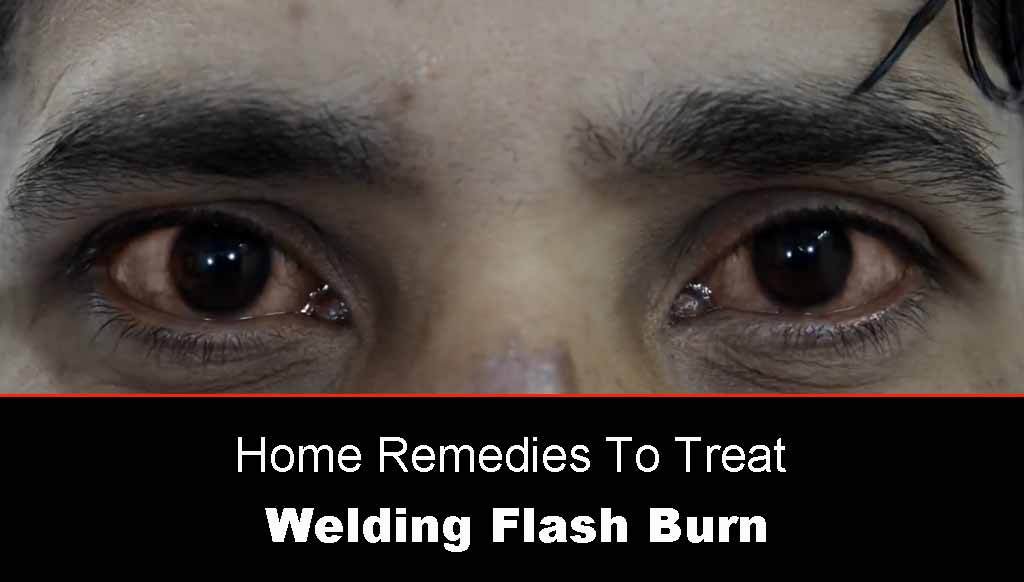
Using welding goggles that aren’t dark enough for your specific application isn’t just uncomfortable—it causes real, measurable damage to your vision. Photokeratitis (welder’s flash) results from UV radiation burning your cornea, causing symptoms like intense pain, tearing, and light sensitivity that appear 6-12 hours after exposure.
Long-Term Vision Consequences of Inadequate Protection
Repeated exposure to welding arcs with insufficient eye protection leads to cumulative damage:
– Cataracts: Clouding of the eye’s lens from UV exposure
– Macular degeneration: Damage to central vision from blue light exposure
– Pterygium: Abnormal tissue growth on the eye surface
– Retinal burns: Permanent blind spots from intense IR radiation
Critical fact: Your eyes don’t develop “toughness” to welding arcs over time—each exposure causes additional damage. The ANSI Z87.1 safety standard exists for good reason, and compliance isn’t optional for professional welders.
Shade Selection Quick Reference for Common Applications
Skip the guesswork with this field-tested shade guide for everyday welding scenarios:
Light Industrial & Automotive Applications
- Auto body MIG (90-130A): Shade 10-11
- Farm equipment repair (Stick, 90A): Shade 10
- Exhaust system fabrication: Shade 9-10
- Aluminum trailer welding (TIG): Shade 11-12
Heavy Industrial Applications
- Structural steel (Stick, 200A+): Shade 12-13
- Pipeline welding (SMAW): Shade 11-12
- Shipyard aluminum welding: Shade 12-13
- Carbon arc gouging: Shade 14 (non-negotiable)
Advanced Shade Selection Strategies
Professional welders use these expert techniques to optimize both safety and productivity:
Fine-Tuning Shade Levels for Specific Challenges
- When welding reflective materials like stainless steel or aluminum, increase your shade by 1 to counteract reflected brightness
- In confined spaces with multiple reflective surfaces, opt for a slightly darker shade than standard recommendations
- For overhead welding where visibility is critical, consider a variable-shade ADF set to the minimum safe darkness level
Lens Quality Matters More Than You Think
A premium Shade 10 lens provides better optical clarity and more consistent UV/IR filtration than a budget alternative. High-quality lenses maintain true color perception, reducing eye strain during long welding sessions. Look for the ANSI Z87.1+ certification mark—this indicates impact resistance beyond basic safety standards.
Final Safety Checklist Before You Weld
Before striking your next arc, verify these critical eye protection factors:
- Confirm shade matches your amperage and process using the charts in this guide
- Inspect lenses for scratches or damage that compromise protection
- Ensure proper helmet fit to prevent light leakage around the edges
- Wear safety glasses underneath (ANSI Z87.1 rated) for protection from sparks when the helmet is up
- Check auto-darkening helmet batteries if using an ADF—weak batteries cause slow response times
Your vision is irreplaceable, and the momentary convenience of using slightly lighter welding goggles isn’t worth the risk of permanent eye damage. When you understand exactly how dark welding goggles need to be for your specific application—and why the shade number system follows an exponential scale—you transform eye protection from a guessing game into a precise safety practice. Always err on the side of darker protection when uncertain, and remember that the perfect shade level balances maximum safety with just enough visibility to produce quality welds. Your eyesight depends on getting this critical detail right every single time you weld.