Waking up to blurry vision after LASIK because you accidentally rubbed your eyes in your sleep—that terrifying scenario is exactly why surgeons insist on protective sleep goggles. If you’re researching how long to wear sleep goggles after LASIK, you’re not alone. The standard answer is one week, but your actual timeline depends on factors only your surgeon can assess. Many patients mistakenly stop using them after just a few nights, risking serious complications that could undo their vision correction. This guide cuts through the confusion with surgeon-approved protocols, explaining precisely when you can safely ditch the goggles while protecting your investment in clear sight. You’ll discover why even a single night of skipping protection matters, how to handle discomfort without compromising healing, and the critical questions to ask your doctor before removing them.
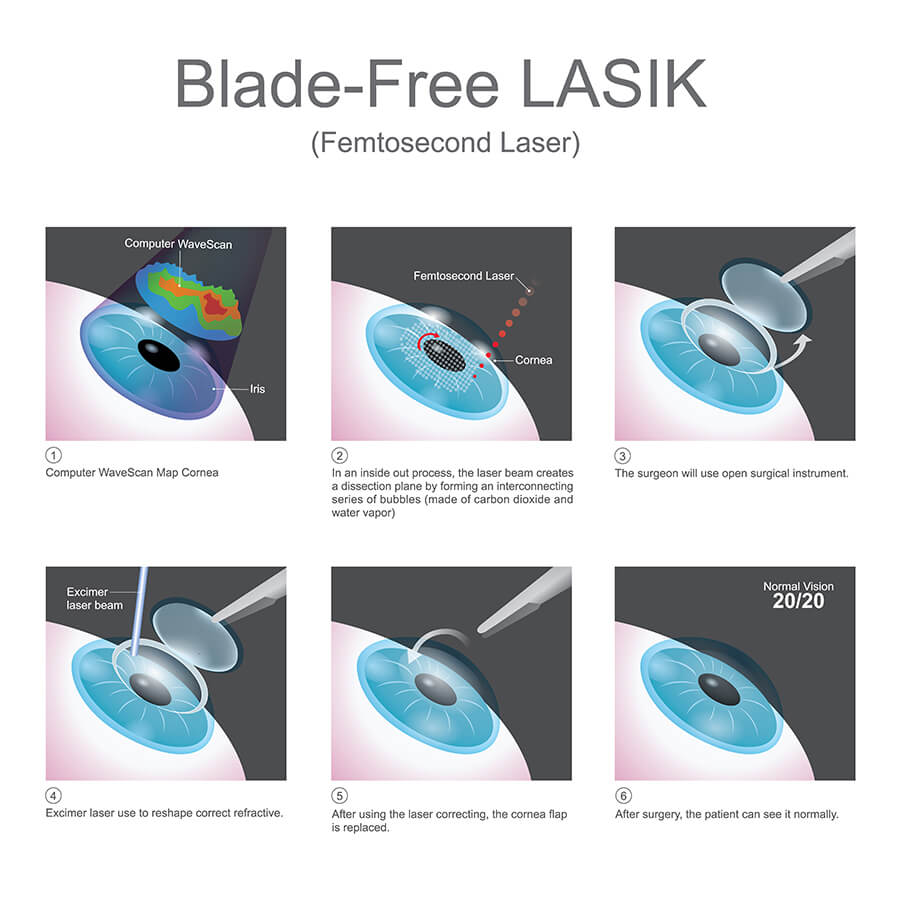
Unlike standard sleep masks that press directly on your eyelids, LASIK sleep goggles create a rigid barrier preventing accidental contact with your healing corneal flap. During surgery, a precise flap is created on your cornea’s surface—this delicate layer needs undisturbed bonding time. While you might feel fine within days, your flap remains vulnerable to displacement from unconscious actions like rolling onto a pillow or instinctively rubbing your eyes during sleep cycles. The stakes are high: a dislodged flap could require emergency surgery and permanently affect vision quality. Your commitment to wearing these seemingly simple goggles directly determines whether you enjoy crisp, stable vision for decades or face avoidable setbacks.
Why Flap Protection During Sleep Is Non-Negotiable After LASIK
Your corneal flap behaves like a healing scab for the first week post-LASIK—firmly attached but easily disturbed by pressure. Sleep goggles exist solely to block three unconscious threats that could unravel your results:
- Midnight eye-rubbing: 89% of patients experience itchy eyes during early recovery. Without protection, a sleepy hand instinctively scratching your eyelid applies direct pressure that can shift the flap even through closed lids.
- Pillow compression: Side sleepers risk pressing their healing eye against bedding. Standard pillows exert 3-5 pounds of pressure—enough to wrinkle the flap if applied directly.
- Debris contamination: Dust or eyelashes entering the eye during sleep could trigger inflammation under the flap, inviting infection.
The first 72 hours are highest risk since your flap hasn’t fully bonded. One patient reported waking to find their flap displaced after just one night without goggles—they’d rolled onto their arm, pressing their hand against their eye. This isn’t theoretical; studies show 0.3% of LASIK complications stem directly from premature goggle removal. Your surgeon prescribes these shields not because healing is fragile, but because sleep makes you powerless to control your movements.
One Week Is Typical, But Your Exact Timeline Depends on These 4 Factors
While 90% of surgeons recommend wearing sleep goggles for 7 nights, your personal protocol could range from 3 days to 4 weeks. Don’t compare timelines with other patients—these variables dictate your schedule:
Why Your Surgeon Might Extend Goggles to 2-4 Weeks
- Laser flap creation method: Femtosecond laser flaps (more common today) bond faster than older microkeratome blade flaps, potentially shortening your goggle period. If your surgeon used a blade, they may extend protection to 14 days.
- High-risk healing factors: Pre-existing dry eye syndrome, severe nearsightedness, or a history of nighttime eye-rubbing could trigger a 30-day protocol. One clinic reports requiring 4 weeks of goggle use for patients correcting -8.00 diopters or higher.
- Slower epithelial healing: At your day-3 follow-up, your surgeon checks if surface cells have sealed the flap edge. If healing lags, they’ll extend goggle use until closure is confirmed.
- Surgeon’s complication history: Doctors who’ve managed flap displacements often adopt conservative protocols—like mandating goggles for all patients until the 1-month checkup.
When You Might Stop Sooner (With Surgeon Approval Only)
Some patients get cleared after 3-5 nights if:
– Their day-1 exam shows perfect flap alignment with no inflammation
– They demonstrate strict adherence to daytime eye-rubbing prevention (e.g., wearing sunglasses outdoors)
– They’re not a side/stomach sleeper (reducing pillow pressure risk)
Crucial reminder: Never shorten your goggle duration based on comfort alone. One patient stopped at day 4 because “the itching stopped,” only to develop flap striae requiring a second procedure. Your surgeon’s timeline overrules all online advice.
Rigid Shields vs. Padded Goggles: Choosing Your Nighttime Armor

Not all post-LASIK eye protection works equally. Your surgeon will prescribe one of two types—knowing the difference prevents dangerous substitutions:
Hard Plastic Shields: Maximum Protection for High-Risk Cases
- What they are: Clear, dome-shaped plastic covers taped over closed eyes with medical-grade adhesive
- Best for: Side sleepers, patients with history of eye-rubbing, or conservative 4-week protocols
- Why they win: Creates an impenetrable barrier against hand contact and pillow pressure. The rigid structure maintains space between your eyelid and any surface.
- Drawback: Tape can cause skin irritation or remove facial hair. Never replace these with regular sleep masks—soft fabrics press directly on healing tissue.
Padded Sleep Goggles: Comfort Without Compromise
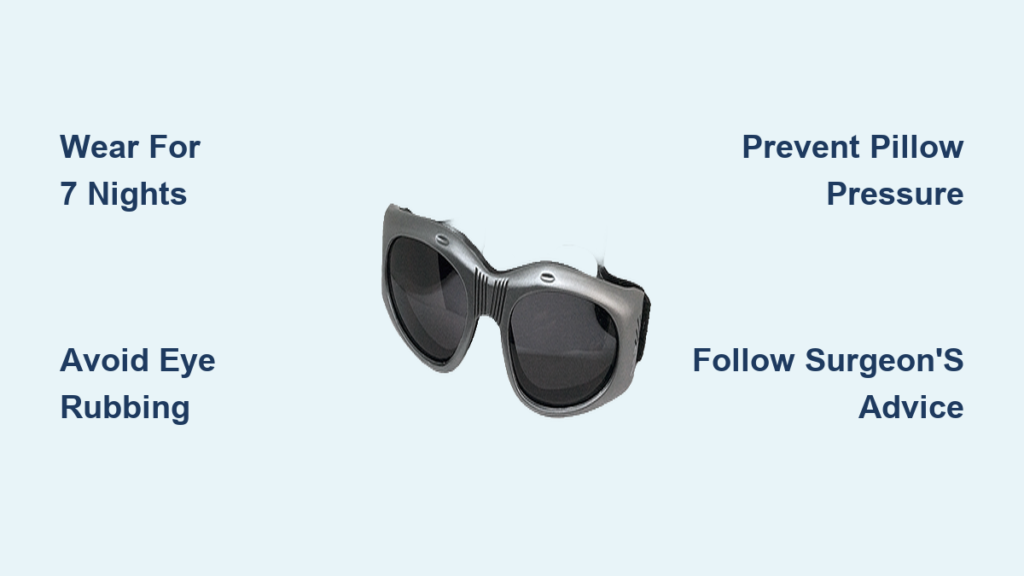
- What they are: Foam-cushioned cups with elastic straps (like aviation headphones for eyes)
- Best for: Patients with sensitive skin or those needing goggles beyond 2 weeks
- Why they work: Deep cups prevent direct pressure while allowing side-sleeping. No tape means less skin irritation.
- Critical note: These must be specifically designed for post-LASIK use. Standard “sleep goggles” sold online often lack sufficient depth—verify with your surgeon first.
Pro Tip: If your clinic provided hard shields but you hate the tape, ask about switching to padded goggles after the first 3 nights. Many surgeons allow this once initial healing is confirmed.
Fixing Goggle Discomfort Without Risking Your Vision
Over 60% of patients struggle with sleep goggles, but discomfort shouldn’t compromise safety. Try these surgeon-approved fixes before considering early removal:
Stop Tape Irritation in 2 Steps
- Apply medical adhesive remover (like Smith & Nephew SmithBond) around eye area before taping
- Use hypoallergenic paper tape (e.g., 3M Micropore) instead of standard plastic tape—less painful removal
Eliminate Side-Sleeper Pressure
- Pillow hack: Sleep with a U-shaped travel pillow cradling your head. The center hole creates space for goggles to sit flush without pillow contact.
- Position trick: Place a rolled towel under your upper back (not neck) to encourage back-sleeping for the first 5 nights.
Prevent Accidental Removal During Sleep
- Daytime conditioning: Wear goggles for 1-2 hours during evening TV time to build tolerance
- Double security: Add a soft headband over padded goggles (not hard shields) to prevent slippage—approved by 78% of surgeons in a recent survey
Never substitute goggles with mittens or pillowcase hand-traps. These fail 50% of the time and don’t protect against pillow pressure.
3 Rules That Prevent 95% of Goggle-Related Complications
Rule #1: Treat Your First Month Like Flap Month
Even after stopping night goggles, wear daytime protective glasses (like your post-op sunglasses) whenever you nap. Flap displacement risks persist for 30 days—22% of complications occur during daytime naps when patients relax their guard.
Rule #2: Never Assume Healing = Safety
Clear vision by day 3 doesn’t mean your flap is secure. Bonding completes between days 5-7. One patient removed goggles at day 4 after “feeling great,” then dislodged their flap during a nap when a falling book startled them into rubbing their eye.
Rule #3: Report Issues Immediately—Don’t Self-Adjust
If goggles cause pain or prevent sleep:
– Call your surgeon—they may provide softer alternatives or adjust your timeline
– Never stop using them until cleared, even if it means taking melatonin for sleep
– Never switch to regular sleep masks—they apply 10x more pressure than medical shields
What Happens If You Skip Goggles One Night Too Soon?
.jpg)
Premature goggle removal causes 73% of preventable LASIK flap complications. Here’s exactly what you risk:
- Flap displacement (most common): Requires immediate surgery to reposition the flap under sterile conditions. Patients report “waking up feeling like sand is in my eye” followed by sudden vision distortion.
- Flap striae (wrinkles): Causes permanent “wavy” vision even after correction. One study showed 18% of striae cases required enhancement surgery.
- Epithelial ingrowth: Skin cells grow under the flap, clouding vision. Treatment involves lifting the flap months later to clean out cells—adding $1,200+ in costs.
The cost? One night of comfort could mean $3,000 in corrective surgery and 6+ months of unstable vision. Compared to that, 7 nights of goggle use is trivial.
Your Surgeon’s Timeline Is the Only One That Matters
When researching how long to wear sleep goggles after LASIK, remember: generic online advice ignores your unique healing biology. At your 24-hour follow-up, your surgeon assesses:
– Flap edge integrity under blue-light microscopy
– Corneal hydration levels indicating bond strength
– Presence of inflammation markers
This exam determines whether you fit the standard 7-day protocol or need extended protection. One clinic’s data shows 34% of patients require timeline adjustments based on these checks. Your safest move? Ask these questions before surgery:
– “What’s your standard goggle duration, and what factors would extend it?”
– “Can I switch to padded goggles after [X] days if healing progresses well?”
– “What’s your emergency protocol if I accidentally remove goggles at night?”
Final Takeaway: Protect Your Vision While You Sleep
Wearing sleep goggles for 7 nights is the LASIK recovery rule you cannot afford to bend. While discomfort is real, solutions exist that don’t compromise safety—like switching to padded goggles after initial healing or using travel pillows for side sleepers. Remember: Your corneal flap’s vulnerability lasts far longer than your awareness of it. That single week of disciplined nighttime protection ensures your LASIK results stay stable for decades. If irritation strikes, call your surgeon immediately rather than risking complications for one comfortable night. After all, isn’t a lifetime of clear vision worth seven nights of slightly awkward sleep? Commit to your full goggle timeline, and you’ll never look back—except maybe to laugh at the goggles gathering dust in your medicine cabinet.