You’re pushing through a brutal off-road race, sweat dripping into your eyes, and suddenly a wall of mud hits your goggles—completely blinding you. In this critical moment, standard goggles would force you to stop and clean them, costing precious seconds. But with roll-off goggles, you simply pull a lever and instantly regain perfect vision. How do roll-off goggles work to solve this life-or-death visibility problem in extreme conditions? Unlike conventional eyewear that fogs and clogs, these specialized systems provide racers with continuous clear vision through a brilliant mechanical solution that works while you’re moving at full speed.
Imagine navigating a treacherous trail at 60 mph when a rider ahead kicks up a rooster tail of mud that coats your lenses. Without roll-off technology, you’d have to pull over, remove your gloves, and manually clean each lens—time you don’t have in competition. This isn’t just inconvenient; it’s dangerous. Roll-off goggles eliminate this problem entirely by incorporating a self-contained lens replacement system that operates with one hand while you maintain control of your vehicle. In this guide, you’ll discover exactly how these ingenious systems function, why they’re essential for serious off-road athletes, and what makes them superior to traditional goggle solutions.
The Two-Component System That Keeps Your Vision Clear

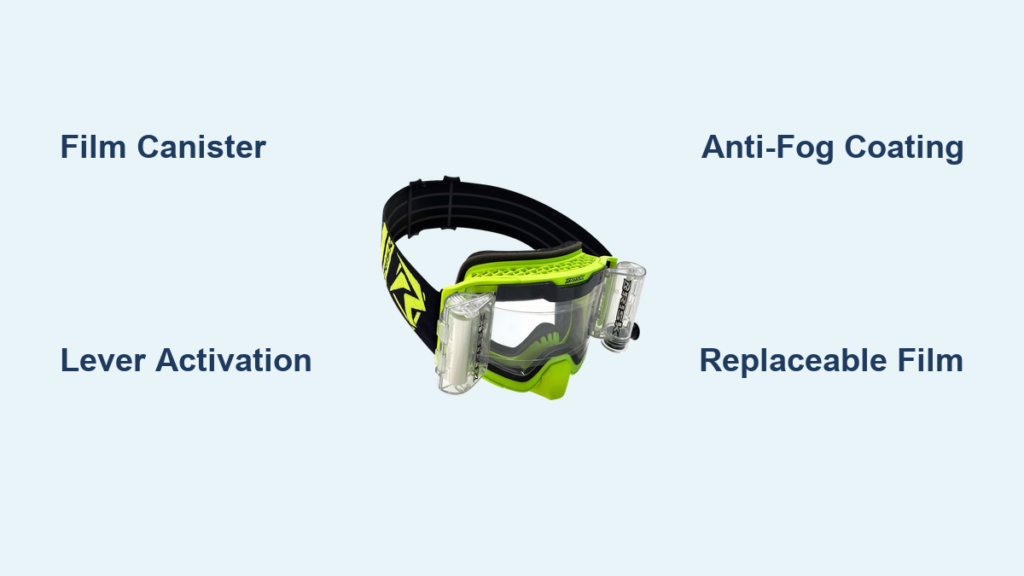
Roll-off goggles function through an integrated mechanical system designed specifically for on-the-go lens replacement. This isn’t just a simple cover—it’s a precision-engineered solution where every component works together to deliver uninterrupted vision. The system consists of two primary elements: the film canister assembly mounted directly on the goggle frame and the activation mechanism that advances the film with minimal effort.
Inside the Film Canister: Your On-Demand Lens Supply
Each roll-off goggle features a compact canister mounted discreetly on the frame (typically the left side for right-handed operation) that houses a continuous roll of specialized optical film. This isn’t ordinary plastic—it’s a durable, optically clear material engineered to resist scratching while maintaining perfect transparency. The film itself measures approximately 0.1mm thick, providing just enough rigidity to stay taut across the lens area while remaining flexible enough to roll smoothly through the mechanism. High-end models use a proprietary polyester film treated with anti-static properties to prevent dust attraction, ensuring each new section provides pristine visibility.
How the Film Path Creates Instant Clarity
The film travels in a precise path from the supply canister across the entire lens area, then winds onto a take-up spool on the opposite side. This creates a protective barrier between environmental debris and the permanent lens beneath. When you activate the system, a fresh section of film pulls across the lens in less than a second, replacing the mud-covered section with crystal-clear visibility. The film advances in precise increments—typically 1-2 inches per activation—ensuring maximum usage of each roll. Most systems provide 20-30 activations per canister, sufficient for even the muddiest races, with some premium models offering up to 50 clean views from a single roll.
Step-by-Step: Activating Clear Vision in Seconds
The true value of roll-off goggles reveals itself in those critical moments when vision becomes compromised. Understanding the exact sequence of events during activation helps you appreciate why this technology has become essential equipment for serious off-road competitors.
When Mud Hits: The Critical Moment for Roll-Off Action
The moment mud or debris obstructs your vision, time becomes your enemy. In traditional goggles, you’d experience a dangerous loss of situational awareness that could lead to crashes or lost positions. With roll-off technology, your response is immediate: without shifting your gaze from the trail ahead, your left hand locates the activation lever positioned ergonomically on the goggle frame. This lever placement allows operation while maintaining full grip on handlebars—critical for maintaining vehicle control during the cleaning process.
Lever Mechanics: How One Pull Resets Your Vision
Pulling the lever engages a precision ratcheting mechanism that advances the film in a controlled manner. As you pull, a gear system rotates the take-up spool while simultaneously releasing tension on the supply canister, allowing the film to feed smoothly across the lens. Higher-end systems incorporate a spring-loaded return mechanism that resets the lever automatically, enabling rapid successive activations if needed. The entire process takes approximately 0.8 seconds—faster than it takes to blink—meaning you regain clear vision before you’ve even registered the obstruction. Some advanced models feature remote activation via handlebar-mounted buttons, allowing completely hands-free operation for ultimate safety.
Why Anti-Fog Technology Makes Roll-Off Systems Superior

While debris protection gets the most attention, fog prevention is equally critical to roll-off goggle performance. Many riders don’t realize that roll-off systems actually provide superior anti-fog protection compared to standard goggles through a dual defense strategy.
Double Defense Against Condensation
Roll-off goggles combat fog through two complementary approaches: the permanent anti-fog coating on the fixed inner lens and the replaceable nature of the outer film. Your breath creates warm, moist air that typically condenses on cooler lens surfaces. In standard goggles, this fog builds up until you can wipe it away—a process that often introduces scratches and oils that worsen future fogging. With roll-off systems, the inner lens maintains its pristine anti-fog coating because it’s protected behind the film layer. When the outer film becomes compromised by dirt or moisture, you simply advance to a fresh section, restoring both clarity and optimal fog resistance simultaneously.
How Permanent Coatings Work with Replaceable Film
The inner lens features a hydrophilic anti-fog treatment that attracts moisture and spreads it into an invisible molecular layer rather than allowing it to form obstructive droplets. This coating remains effective for the life of the goggle because the roll-off film shields it from abrasion and contaminants. Meanwhile, the replaceable film itself incorporates anti-static properties that minimize moisture attraction. This dual-layer approach creates what riders call “self-cleaning fog resistance”—as you advance the film, you’re not just removing debris but also refreshing the entire optical system’s ability to resist condensation.
Who Relies on Roll-Off Goggles in Extreme Conditions

Roll-off technology has moved beyond niche racing applications to become essential equipment for anyone facing challenging off-road conditions. Understanding who uses these systems and why reveals their true performance value.
Motocross Racers’ Secret Weapon in Muddy Conditions
Professional motocross and enduro racers depend on roll-off goggles during wet conditions where roost (kicked-up debris) creates near-zero visibility. In championship-level racing, the ability to maintain clear vision through multiple mud sections can mean the difference between winning and finishing out of the points. Top riders like Eli Tomac and Ken Roczen have credited roll-off technology with improving their performance in notoriously muddy tracks like Budds Creek and Glen Helen. The system’s reliability allows racers to push harder through challenging sections without worrying about sudden vision loss.
Off-Road Drivers’ Essential Gear for Dust Storms
In desert racing events like the Baja 1000, drivers face constant clouds of fine silt that penetrate standard goggles within minutes. Roll-off systems provide truck and buggy drivers with the ability to maintain clear vision through multiple dust sections without stopping—a critical advantage in endurance racing where every minute counts. The remote activation systems mounted on steering wheels have become standard equipment in Trophy Truck and UTV racing, allowing drivers to clear their vision without taking hands off the wheel during high-speed navigation through narrow canyons and dry lake beds.
The Complete Vision System: Beyond Just the Film
Roll-off technology represents only one component of a comprehensive visual solution. Modern systems integrate multiple performance features that work together to deliver superior functionality.
Advanced Ventilation Channels That Prevent Fogging
High-performance roll-off goggles incorporate strategically placed intake and exhaust vents that create continuous airflow across the lens surface. These channels draw cool, dry air from the front of the goggle while expelling warm, moist air from behind the lens. Premium models use computational fluid dynamics to optimize vent placement, creating a laminar airflow that prevents turbulence while maximizing moisture evacuation. The result is a constant exchange of air that significantly reduces the temperature differential between your face and the lens—addressing the root cause of fogging before it can develop.
Multi-Layer Foam Design for Comfort and Performance
The facial foam on roll-off goggles serves multiple critical functions beyond comfort. Triple-layer foam constructions feature moisture-wicking properties that pull sweat away from your skin while maintaining an effective seal against debris. The inner layer uses open-cell foam that allows moisture vapor to escape, while the outer layer employs closed-cell foam that blocks dust and water intrusion. This sophisticated design prevents the buildup of moisture that leads to fogging while ensuring the goggle maintains its position during aggressive riding—critical when you’re bouncing through whoops sections at race speed.
Maintenance Tips to Keep Your Roll-Off System Performing
Proper care extends the life of your roll-off system and ensures reliable performance when you need it most. These simple maintenance practices make a significant difference in real-world reliability.
Proper Film Storage to Prevent Jamming
Always store replacement film canisters in their original packaging until ready for use. Exposure to dust, moisture, or direct sunlight can degrade the film’s optical properties and cause feeding issues. When installing a new canister, verify that the film feeds smoothly through the guide channels before mounting the goggles. If you notice resistance, clean the film path with compressed air—never force the film through the mechanism, as this can cause misalignment.
Cleaning Procedures That Extend System Life
After each use, wipe the goggle frame with a microfiber cloth to remove mud and debris that could interfere with the roll-off mechanism. Never use chemical cleaners on the film path, as residues can cause the film to stick. For the fixed inner lens, use only manufacturer-approved anti-fog solutions that won’t degrade the permanent coating. Periodically inspect the activation lever mechanism for debris buildup, using a soft brush to clean hard-to-reach areas. These simple steps ensure your roll-off system functions flawlessly race after race.
Roll-off goggles represent the pinnacle of off-road visual technology—a mechanical solution to a problem that once plagued every off-road athlete. By understanding how do roll-off goggles work, you can appreciate why they’ve become essential equipment rather than a luxury. The combination of instant lens replacement, superior fog resistance, and seamless integration with your riding position creates a safety and performance advantage that’s difficult to overstate. Whether you’re a weekend warrior tackling muddy trails or a professional racer competing at the highest level, the ability to maintain crystal-clear vision through the toughest conditions transforms your riding experience from frustrating to fearless. For serious off-road enthusiasts, roll-off technology isn’t just about convenience—it’s about maintaining control when visibility matters most.