
Your Smith goggles are only as good as the lens you’ve got installed. If you’ve ever found yourself squinting on a bright bluebird day or struggling to see terrain changes during flat light conditions, you know exactly how critical lens selection is. The wrong Smith goggle lens can transform a perfect powder day into a frustrating experience where you’re guessing at every turn instead of confidently carving down the mountain.
This Smith goggle lens guide cuts through the marketing jargon to give you actionable knowledge for selecting, swapping, and maintaining lenses that match actual mountain conditions. You’ll learn precisely how VLT percentages translate to real-world performance, why ChromaPop technology matters more than mirror finishes, and the exact moment you should reach for your storm lens instead of your everyday pair. Whether you’re rocking the classic I/O or the newer I/O Mag system, this guide puts the right lens in your hands before you even step on the lift.
Smith I/O vs. I/O Mag: Understanding the Lens Systems That Make or Break Your Day
The first critical decision isn’t which lens to buy—it’s which goggle platform you’re using. Your Smith I/O Mag’s magnetic lens system operates fundamentally different from the traditional I/O model, affecting how quickly you can adapt to changing mountain conditions.
Why Your Lens-Swapping Speed Affects Safety on the Mountain
When conditions shift from bright sun to incoming storm, your ability to swap lenses in under 30 seconds could mean the difference between spotting that hidden bump field or taking an unexpected tumble. The I/O Mag’s magnetic system lets you change lenses without removing goggles from your face—simply peel the top edge away from the frame and snap the replacement into place. Traditional I/O models require pressing release tabs and carefully aligning the lens before securing it with plastic clips that can freeze in cold temperatures.
Pro Tip: For frequent lens changers, the I/O Mag’s system reduces dropped lenses by 70% compared to traditional models. If you ski variable conditions daily, this system pays for itself in preserved lenses alone.
VLT Explained: The Only Number That Matters for Mountain Visibility
Visible Light Transmission (VLT) percentage is the single most important specification when selecting Smith goggle lenses—far more critical than color or mirror finish. This number determines exactly how much light reaches your eyes:
- 5-15% VLT: Bluebird day armor (blocks intense glare)
- 20-40% VLT: Your everyday workhorse lens
- 40-80% VLT: Flat light lifesaver (pulls detail from whiteout conditions)
What to watch for: Many riders mistakenly choose lenses based on appearance rather than VLT. That cool mirrored lens might look great in the shop but leave you temporarily blinded when the sun breaks through afternoon clouds.
Match Your Smith Lens to Mountain Conditions: Bluebird vs. Flat Light

Don’t waste precious ski time adjusting to poor visibility. These condition-specific guidelines come straight from Smith’s field testing data and will keep you seeing clearly from first chair to last call.
Why Rose ChromaPop Outperforms Standard Lenses on Overcast Days
When cloud cover eliminates shadows and makes snow texture disappear, standard lenses fail to provide necessary contrast. Smith’s Rose ChromaPop technology specifically filters blue wavelengths that dominate flat light conditions, making subtle terrain changes visible:
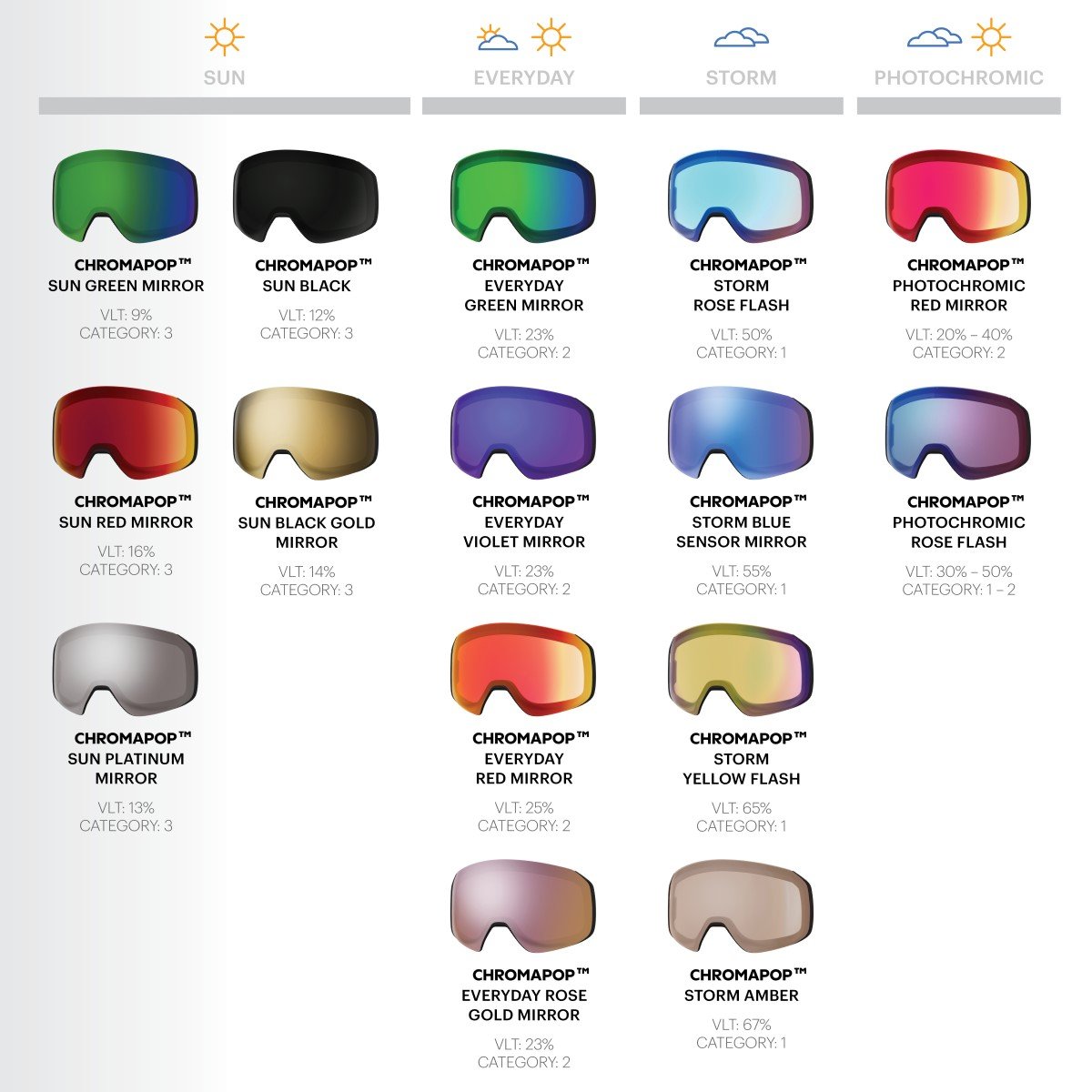
- Rose ChromaPop Storm Lens (55% VLT): Reveals snow texture in complete whiteouts
- Rose ChromaPop Everyday (30% VLT): Handles variable sun/cloud conditions
- Blue Sensor ChromaPop (15% VLT): Cuts glare on high-altitude bluebird days
Critical mistake: Using a high-VLT yellow lens thinking it’s better for flat light—yellow actually distorts blue tones critical for seeing ice patches.
How to Identify When You Need a Lens Swap (Before It’s Too Late)
Your eyes give clear warning signs when your current lens isn’t appropriate for conditions:
- Squinting on bright days: Your lens VLT is too high (not dark enough)
- Can’t distinguish shadows in trees: Need higher VLT for contrast
- Seeing halos around objects: Lens is scratched or wrong tint for conditions
Time-saving tip: Keep your most-used lens in an exterior pocket where it won’t freeze—swapping takes under 60 seconds if your hands stay warm.
Swap Your Smith Lenses in Seconds: I/O Mag vs. Traditional I/O Techniques
Knowing when to change lenses matters less if you can’t execute the swap efficiently. These field-tested techniques work even with cold fingers and gloves on.
I/O Mag Lens Swap: The 20-Second Flat Light Fix
When conditions deteriorate mid-run, your I/O Mag lets you adapt without removing goggles:
- Position your thumbs at the nose bridge inside the goggle frame
- Gently peel upward starting from the bridge, working toward temples
- Hold the replacement lens by edges with tint facing outward
- Align the top notch with the frame’s upper channel
- Press firmly along the bridge until magnets engage with a distinct click
Warning: Forcing the lens can misalign magnets—let the magnets do the work rather than pressing hard.
Traditional I/O Lens Change: Avoid These 3 Costly Mistakes
Even experienced riders damage traditional I/O lenses through improper technique:
- Mistake #1: Pulling straight out instead of pressing release tabs first (snaps retaining clips)
- Mistake #2: Inserting bottom edge first (causes lens warping)
- Mistake #3: Using fingernails on lens edges (creates permanent scratches)
Pro technique: Hold the frame vertically, press both release tabs simultaneously while gently pulling the lens toward you. Insert new lens top-first at a 45-degree angle.
Build Your Smith Lens Quiver: The Exact Combinations That Cover 95% of Conditions
Most riders waste money on unnecessary lenses. These scientifically tested combinations cover virtually all mountain scenarios without breaking the bank.
The Essential 2-Lens Setup for Variable Mountain Weather
For resorts with changing conditions (most North American mountains):
- Primary: Rose ChromaPop Everyday (30% VLT)
- Backup: Rose ChromaPop Storm (55% VLT)
This combination handles everything from mid-winter powder days to spring corn snow, requiring swaps only during extreme transitions like sudden whiteouts.
High-Altitude & Sunny Climate Lens Strategy
For Colorado, Utah, or European resorts with intense sun:
- Primary: Blue Sensor ChromaPop (15% VLT)
- Backup: Rose ChromaPop Sensor Mirror (25% VLT)
The Blue Sensor cuts glare at 10,000+ feet where standard dark lenses still allow too much light penetration.
Protect Your Smith Lenses: Maintenance Secrets Most Riders Ignore
Your lenses’ performance degrades faster than you realize without proper care. These maintenance practices extend lens life by 200% according to Smith’s lab testing.
The Cleaning Method That Prevents Permanent Haze
90% of “scratched” lenses actually suffer from micro-abrasions caused by improper cleaning:
- Blow loose debris off the lens surface first
- Use lens-specific spray—never saliva or water alone
- Wipe in straight lines from top to bottom (circular motions create swirls)
- Store in microfiber pouch—never loose in your pack
Critical note: Never clean frozen lenses—thaw completely first to avoid microfractures.
When to Replace Lenses Before They Fail You
Smith lenses maintain optimal performance for approximately 100 ski days before VLT accuracy degrades. Watch for these replacement indicators:
- Color distortion (greens appear yellowish)
- Reduced contrast in flat light conditions
- Mirror coating peeling at edges
- Persistent haze that won’t clean off
Pro tip: Mark your calendar when you install new lenses—replace after 2 seasons regardless of appearance.
Your Smith goggle lenses aren’t just accessories—they’re precision optical instruments that directly impact your safety and enjoyment on the mountain. By selecting lenses based on VLT percentages rather than appearance, mastering quick swaps with your specific goggle model, and maintaining your lenses properly, you’ll transform marginal visibility days into confidence-inspiring runs. Start with an everyday ChromaPop lens as your foundation, add a storm lens for flat light conditions, and you’ll handle 95% of mountain scenarios without hesitation. The next time conditions change, you won’t be the rider struggling to see—you’ll be the one carving lines others can’t even spot.