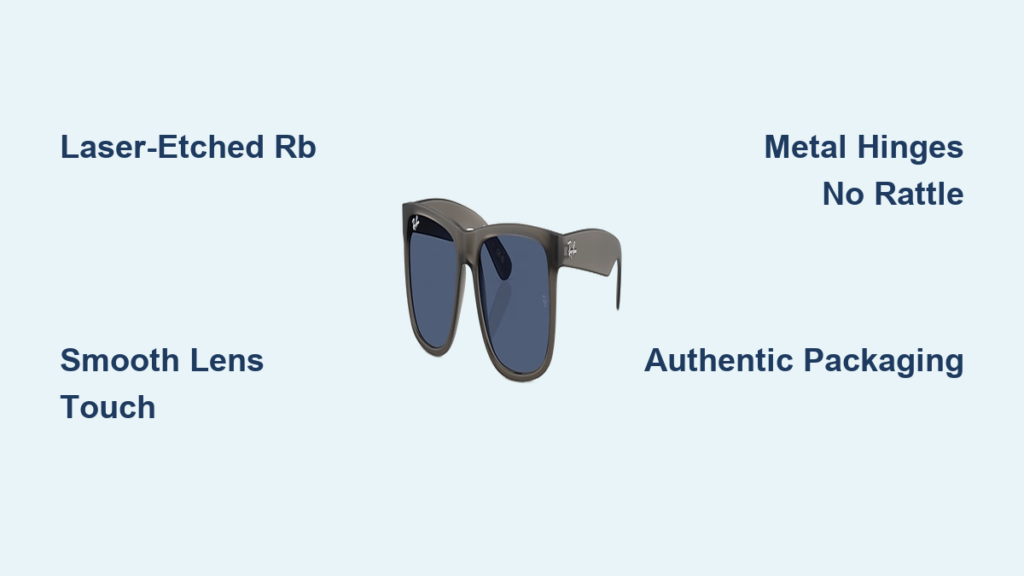
You spot a pair of Ray-Bans online for half the retail price. The Aviator style looks right, the case seems authentic, and the box has the red Ray-Ban logo. But something feels off. Could they be fake?
Counterfeit sunglasses account for up to 20% of global eyewear sales, making authentic Ray-Ban verification more important than ever. Fake lenses often lack proper UV protection, which can cause pupil dilation and actually increase your risk of cataracts and retinal damage. The good news: genuine Ray-Bans follow strict manufacturing standards, and by knowing what to check, you can spot fakes in under 60 seconds. This guide walks you through 12 key authentication points, from laser-etched lens markings to packaging details and purchase red flags.
How to Identify Authentic Ray-Ban Lens Etchings
The most reliable first test for authenticity is examining the laser-etched branding on the lenses. Counterfeits often skip or poorly replicate this precision detail.
Check the “RB” Marking on the Left Lens
All genuine Ray-Ban sunglasses feature a tiny, crisp “RB” etched into the bottom corner of the left lens. This marking is laser-etched directly into the lens surface, not printed, painted, or stickered.
The etching should feel completely smooth to the touch with no raised texture. Try gently running your fingernail across it: if it smudges, flakes, or rubs off, the sunglasses are counterfeit. Pre-1999 models made under Bausch & Lomb may show “BL” instead of “RB,” but only on vintage pairs. If the “RB” is missing, blurry, or appears on the right lens instead, the sunglasses are fake.
Verify the “Ray-Ban” Logo on the Right Lens
On the top corner of the right lens, look for the cursive “Ray-Ban” logo, also laser-etched with precision. The script should be elegant and flowing with consistent thickness and no jagged edges. Use a magnifying glass or your smartphone’s macro camera mode to examine the depth and clarity.
Shallow, uneven, or printed logos are dead giveaways of counterfeit production. Authentic etching sits below the lens surface and catches light differently than surface printing.
Identify Polarized Lens Markings
If the sunglasses claim to be polarized, the right lens will include additional etching. Look for a capital “P” next to the Ray-Ban logo, or the word “POLARIZED” etched beneath the logo. These markings are never printed or stickered. Fakes often omit this detail entirely or use incorrect fonts and formatting.
Inspect the Lens Sticker
Some new authentic Ray-Bans include a small metallic, reflective sticker on one lens, usually the left. The sticker should be shiny and professionally applied, not dull, matte, or easily removable. Fake versions often use cheap stickers that peel or lack proper reflectivity. However, never rely on the sticker alone: lack of proper lens etching is an immediate red flag.
How to Test Ray-Ban Lens Quality and UV Protection

Beyond branding, the performance and material of the lenses reveal authenticity through optical quality and safety compliance.
Distinguish Glass from Polycarbonate Lenses
Genuine Ray-Bans use high-grade materials. Glass (crystal) lenses are found in premium models, feel heavier, and produce a clear, high-pitched tap when lightly tapped with a fingernail. Polycarbonate lenses are standard in most modern styles, lightweight but durable.
Counterfeits use low-quality plastic that feels too light, scratches easily, and may warp under heat. Run your fingernail lightly across the lens surface: authentic glass or polycarbonate resists scratching, while fakes often show immediate marks.
Test Optical Clarity and Distortion
Put the sunglasses on and look at straight lines, such as window frames or door edges. Authentic lenses provide crisp, undistorted vision across the entire field with no blurriness, waviness, or color fringing at the edges. Fakes often have uneven tinting, bubbles, or hazy spots, especially near the lens periphery.
Verify UV Protection for Eye Safety
All real Ray-Bans block 100% of UVA and UVB rays. This is confirmed by CE (Europe) or UKCA (UK) marks on the frame. Fake sunglasses may have dark lenses without UV filtering, which causes pupils to dilate and increases retinal exposure. Wearing fake UV-blocking sunglasses is more dangerous than wearing none at all.
Long-term use of counterfeit lenses increases your risk of cataracts, macular degeneration, and photokeratitis (corneal sunburn). Only genuine Ray-Bans meet EN ISO 12312-1:2013 (EU) and ANSI Z80.3 (US) safety standards.
How to Assess Ray-Ban Frame Construction and Weight
The frame’s feel, weight, and construction are instant authenticity indicators that take seconds to check.
Examine Acetate Frames (Wayfarer, Clubmaster)
Models like the Wayfarer and Clubmaster use high-grade acetate cut from a single block. The surface should be polished but not slippery, with slight texture under close inspection. Run your finger along the temples: real acetate feels dense and refined, while fakes feel grainy or hollow.
Look for visible mold lines, seams, or discoloration. Authentic frames have none of these. The frame should feel substantial and well-balanced, not flimsy or overly light.
Inspect Metal Frames (Aviator, Round Metal)
Aviators and Round Metal frames use high-grade metal alloys with uniform plating. Check for even coloring with no flaking chrome or oxidation. Fake metal frames often chip within days of use and show signs of weak construction.
Perform the Weight Test
Authentic Ray-Bans have substantial, balanced weight due to premium materials. For example, the RB4165 Justin weighs 31-32 grams, while the RB3025 Aviator weighs approximately 30 grams. Counterfeits usually weigh under 28 grams due to low-density plastics. If the sunglasses feel too light or flimsy, they are likely fake.
They should also sit comfortably balanced on your face with no top-heaviness or temple droop.
How to Inspect Ray-Ban Hinges for Authenticity
The hinges are a counterfeit weak spot. Fakes often use plastic or glue instead of the solid metal construction found in genuine Ray-Bans.
Check Seven-Prong Hinges (Pre-2010 Models)
Older authentic Ray-Bans feature a seven-prong (seven-finger) hinge with three prongs on one side and four on the other. This interlocking metal design is secured with metal rivets or screws. The complex mechanism is hard for counterfeiters to replicate, so fakes often use fewer prongs or flat plastic joints.
Examine Three-Prong Hinges (Post-2010)
Some newer models use three-prong metal hinges, but they are still made of solid metal, not plastic. Screws should be round, prominent, and flush with the surface. Fake versions use recessed flat screws or rely on glue.
Test Hinge Quality
Genuine hinges operate smoothly and tightly with no wobble or play. When shaken, they make no rattling sound. The temples should stay firmly open without drooping. If the arms sag, rattle, or feel loose, the sunglasses are counterfeit.
On acetate frames like Wayfarers, hinges are secured with four metal rivets: two visible from the front and two from the side. Counterfeits may use fewer rivets or rely entirely on adhesive.
How to Decode Ray-Ban Nose Pads and Temple Markings
Internal markings on the nose pads and temple arms are gold-standard authenticity checks that take seconds to verify.
Inspect Nose Pad Engravings
On metal-frame Ray-Bans, the center metal inlay of each nose pad is engraved with “R•B” (R dot B). The dot is small and centered between the letters. The engraving is recessed and crisp, not painted or stamped. The pads are transparent or light peach in color, never white or opaque.
Fakes often lack this marking entirely or have poorly imprinted versions that look stamped rather than engraved.
Verify Left Temple Arm Markings
Flip up the left temple arm and check the interior. You should see a model number starting with “RB” (such as RB2140, RB3025, or RB4165), followed by the frame size in the format “Lens Width □ Bridge Width” (for example, 50□18), and optionally a color code.
The text must be laser-etched or deeply printed, centered, aligned, and smudge-free. It should exactly match the number on the box. Misaligned, smudged, or missing text is a major red flag.
Check Right Temple Arm Markings
The right temple arm interior includes “Made in Italy” or “Made in China,” the “Ray-Ban” brand name, the CE mark (EU) or UKCA mark (UK), and “Polarized” if applicable. These confirm compliance with international safety standards.
Made in China is valid for modern models, as Luxottica manufactures some lines there under strict quality control. However, Made in China on vintage-style frames is suspicious. No CE or UKCA mark? Likely counterfeit.
How to Verify Ray-Ban Model Numbers
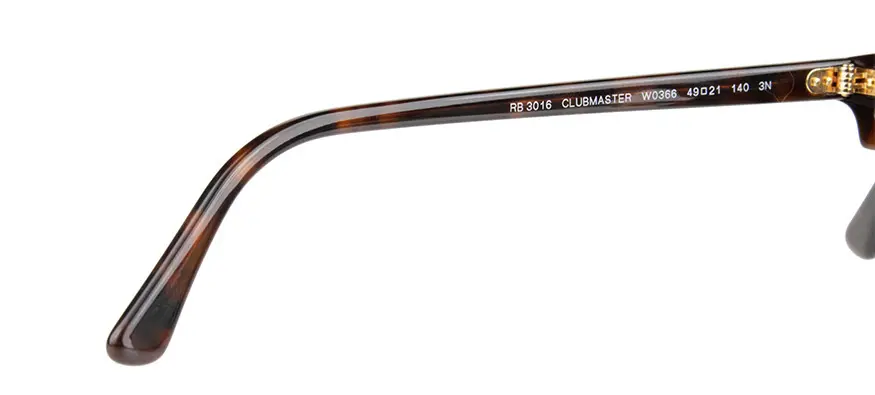
The model number is your direct link to authenticity and takes seconds to cross-reference.
Locate and Decode the Model Number
Example: RB4165 58-15 901/58 breaks down as RB4165 (model, Justin), 58-15 (lens width 58mm, bridge 15mm), and 901/58 (color code, Black Matte). Every digit must exactly match the product listing.
Cross-Check on Ray-Ban.com
Visit ray-ban.com and search the model number. If it does not appear in current or archived collections, it is fake. Compare lens color, frame size, and style to ensure they match exactly.
Contact Customer Service
Ray-Ban offers official verification. Provide the model number and batch code from the box, and customer support can confirm whether it matches production records.
How to Inspect Ray-Ban Packaging and Accessories
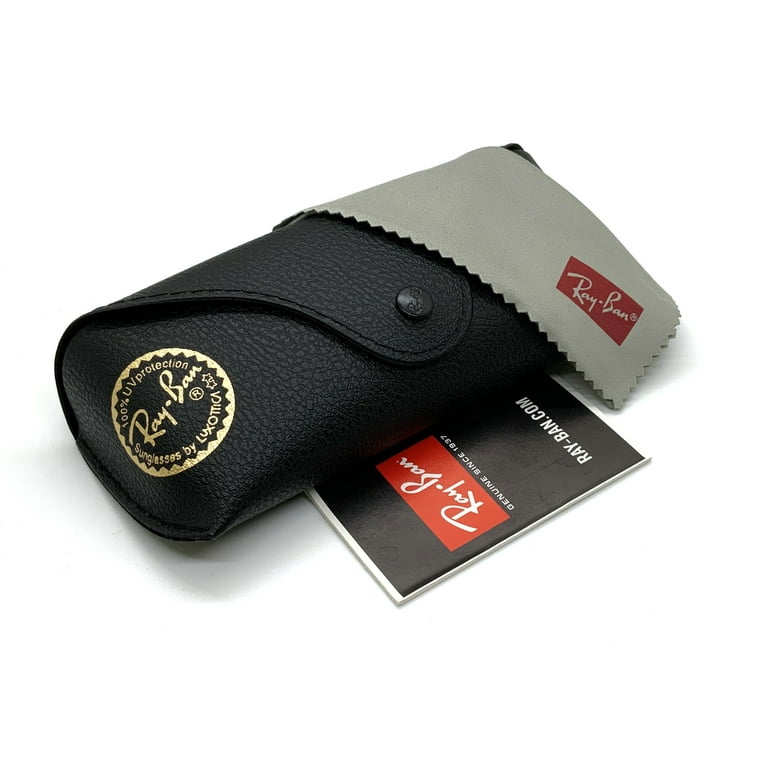
Counterfeits often fail at packaging, where details are off by millimeters. Inspect these elements carefully.
Examine the Original Box
Authentic Ray-Ban boxes have a metallic gray exterior with a bright red “Ray-Ban” logo. The logo includes a dash (Ray-Ban) and has a textured or slightly glossy finish, not flat or matte. The label should include a unique alphanumeric serial code, barcode, model number, size, and manufacturer (Luxottica or EssilorLuxottica).
Fake boxes use dull red, incorrect fonts, flat surfaces, and may lack a serial number or include only a QR code. Real boxes always have both a serial code and barcode.
Check the Protective Case
Genuine cases are black or brown faux leather with a felt-lined interior. The front emblem features the Ray-Ban logo, “100% UV protection” at the top, and “Sunglasses by Luxottica” at the bottom. The snap closure has an embossed logo and subtle rebound texture.
Fake cases lack felt lining, use matte or poorly stamped logos, and may miss “Luxottica” or use incorrect text.
Inspect the Cleaning Cloth
Authentic cloths are soft microfiber that is durable with no fraying. The “Ray-Ban” or “RB” is woven or printed into the fabric. Counterfeit cloths are thin, generic, or unbranded, and may say “Rayban” (without the dash) or use fake fonts.
Review the Instruction Booklet
Real booklets are printed on high-quality paper with crisp print and include care instructions, warranty information, and Luxottica manufacturer details. There should be no typos or blurry images.
Fakes often have “Lomb Bausch” or mention a “Club Master Certificate,” which Ray-Ban has never issued. Poor alignment and low-resolution logos are also telltale signs.
Look for Protective Film
Critical rule: genuine Ray-Bans never ship with plastic protective film over the lenses. If you see a peel-off film, the sunglasses are definitely counterfeit.
Where to Buy Authentic Ray-Bans
Even perfect fakes fail the source test. Knowing where to purchase matters as much as knowing what to check.
Understand Retail Pricing
Authentic Ray-Bans typically retail between $130 and $200, depending on the model. Authorized dealers may offer up to 30% off during sales. Prices under $90 are highly suspicious for current models.
Ray-Ban enforces strict pricing through EssilorLuxottica, so deep discounts are rare. If a deal seems too good to be true, it probably is.
Buy from Authorized Retailers Only
Purchase from ray-ban.com (official site), Sunglass Hut, FramesDirect.com (Ray-Ban Certified), Eyebuydirect, Feel Good Contacts, Trovelle, or licensed opticians. Verify dealer status on Ray-Ban’s official site before purchasing.
Avoid These Sellers
Never buy from eBay third-party sellers, Amazon (unless directly from Ray-Ban or a certified dealer), social media marketplaces, street vendors, or pop-up shops. These channels are flooded with counterfeits. No secure checkout or return policy? Walk away.
Ray-Ban Warranty and Customer Protection
Real Ray-Bans come with a limited two-year warranty covering defects in materials, workmanship issues, and lens coating failures. This requires proof of purchase from an authorized dealer.
Some retailers offer extended warranties for scratches or breakage. Counterfeits offer no warranty, returns, or customer support.
Frequently Asked Questions About Ray-Ban Authentication
Can I tell if Ray-Bans are fake by the price alone?
No. While prices under $90 are highly suspicious, counterfeiters often price fakes at or near retail to appear legitimate. Always verify the physical authentication points regardless of price.
Do all authentic Ray-Bans say “Made in Italy”?
No. Modern Ray-Bans are made in both Italy and China under Luxottica supervision. Both are legitimate. The key is that the country of origin must be clearly marked on the right temple arm alongside the CE or UKCA mark.
What if my Ray-Bans have “BL” instead of “RB” on the lens?
Pre-1999 vintage models made under Bausch & Lomb may have “BL” instead of “RB.” However, if you are buying new sunglasses and see “BL,” they are fake, as Ray-Ban has not used Bausch & Lomb branding for over 25 years.
Are polarized Ray-Bans more likely to be fake?
Polarized models have additional etching (“P” or “POLARIZED”) that counterfeiters frequently forget orincorrectly format. While fakes exist, the extra marking provides another verification point. Always check for proper polarized etching on claims of polarization.
Can I verify authenticity just by checking the case and box?
No. Packaging is important, but it is only one part of authentication. Always check lens etching, frame construction, temple markings, and hinge quality in addition to packaging. Counterfeiters often replicate packaging well while failing on the sunglasses themselves.
What should I do if I suspect I bought fake Ray-Bans?
Contact the seller immediately for a return or refund. If purchased from an unauthorized seller on a marketplace platform, report the listing. For genuine eye safety, stop wearing the sunglasses and dispose of them properly. Your eyes are not worth the risk.
Key Takeaways for Verifying Authentic Ray-Bans
Authenticating Ray-Ban sunglasses comes down to knowing what genuine construction looks and feels like. Start with the lens etching: genuine pairs have crisp, laser-etched “RB” on the bottom left lens and the cursive “Ray-Ban” logo on the top right lens. These cannot be scratched off and should feel completely smooth to the touch.
Always verify the temple arm markings, including the model number on the left arm and the country of origin plus CE or UKCA mark on the right. Check that hinges are solid metal with no rattling or play. Weigh the sunglasses against known authentic specifications.
Finally, only buy from authorized retailers. The small premium you pay for genuine Ray-Bans buys UV protection, optical clarity, durable construction, and a two-year warranty. Fakes compromise your eye safety and will not last a season. When in doubt, buy from ray-ban.com or an authorized dealer. Your eyes deserve the real thing.